Overview of updates on the 2026 Bangladesh minimum wage negotiations
This is the CCC live blog on the Bangladesh Minimum Wage Negotiations – 2026
Our aim is to update this blog regularly during the minimum wage negotiations in Bangladesh. A quick overview to get you up to speed on everything that happened before we started this live blog:
In July 2026, trade unions in Bangladesh called on the Ministry of Labour to form a Wage Board, in line with the newly adopted labour law that prescribes a minimum wage revision once every three years. The last minimum wage negotiations for the garment sector took place in 2023.
On October 29, the IndustriALL Bangladesh Council called for the new minimum wage to be set at Tk32,000 (260 USD/230 EUR) per month.
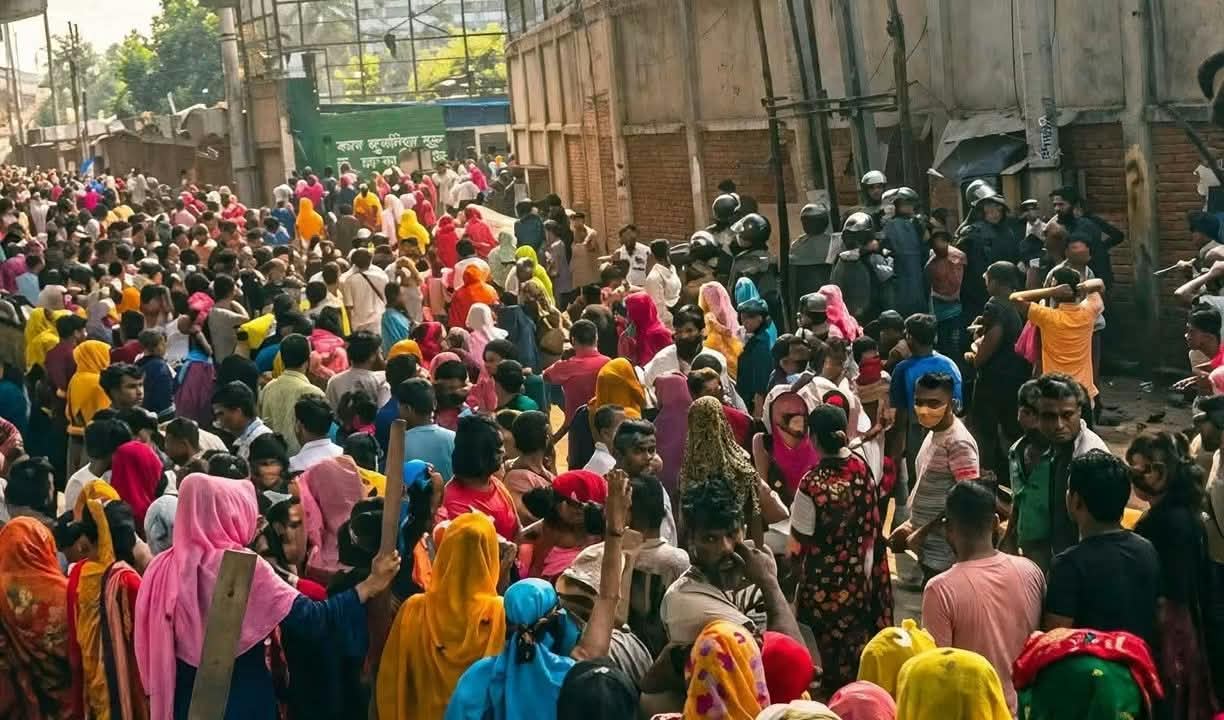
On October 31st, workers in several districts started protesting to demand the immediate formation of a new Wage Board and an increase of the minimum wage to at least Tk30,000. Several main roads were blocked by protesters.
On November 1st, the government of Bangladesh announced the formation of a Wage Board. In the meantime protests had taken over Dhaka and over 600 factories announced factories would remain closed the next day due to unrest. Many factories have remained shut ever since.
Update November 15:
On Saturday and Sunday, nearly 150 factories remained shut due to ongoing unrest in several areas of Dhaka (Ashulia, Savar, Gazipur). The BGMEA said that they expect that more factories might enforce the “no work, no pay” provision if they are unable to operate normally. On Saturday, 55 factories had already enforced the rule and closed indefinitely. Another 92 halted production as well.
During a press conference on Saturday, the BGMEA announced that their participation in the Wage Board meeting scheduled for November 16th depends on how things on the ground unfold.
Meanwhile, support for the workers’ demands came from different groups over the weekend. In Prato, Italy, trade union Sudd Cobas staged a large protest in front of an H&M store together with Bangladeshi and Pakistani workers. The protest in support of garment workers’ wage demands in Bangladesh was held in front of H&M, one of the most important buyers from the Bangladeshi garment sector.
In Belgium, employees of Zara and H&M linked to trade union CNE published a statement in support of and in solidarity with their colleagues in Bangladesh, calling on the brands to support the demand for 32,000 Taka and ensure the increased labour cost would be absorbed by the companies once the new minimum wage is enforced.
Update November 13:
Yesterday, Italian outdoor company Oberalp wrote in a public statement that the company “supports the call for a new minimum wage of Tk 32,000 per month, which we believe represents an important step towards improving the well-being of garment workers and their families.” Oberalp continues to say they commit to continue sourcing from their suppliers in Bangladesh and have no intention to reduce their sourcing activities in the country, also after an increase of the minimum wage. Read Oberalp’s full statement here.
After an emergency meeting held by the BGMEA on Thursday, several garment factory owners have threatened to keep their factories shut for an indefinite period if the wage protests continue. Their workers would not receive their salaries for this period. On Wednesday and Thursday, roughly 100 factories were closed for production.
Update November 12:
Local sources are reporting that landlords of garment workers are already implementing increased rent prices in anticipation of workers earning a higher wage as of January 2027, creating immediately pressure on workers to cover their basic needs. Before the increased rents, workers were already struggling to get by on their current wages.
Update 11 November:
Today Clean Clothes Campaign, along with several trade unions and labour rights organisations, held a press briefing about the ongoing Bangladesh minimum wage struggle. You can watch a recording of the session below. For any follow-up press inquiries you can reach out to Anne Bienias at annebienias@cleanclothes.org
Update 9 November:
- During a meeting of the Wage Board today, labour representatives on the Wage Board proposed wage levels for all wage grades for 2027. They proposed: Tk 48,000 for Grade 1, Tk 43,000 for Grade 2, Tk 38,000 for Grade 3 and Tk 32,000 for Grade 4 and Tk 30,000 for apprentice level workers. Many other groups, including the IndustriALL Bangladesh Council, also voiced their demands for the new wage levels to the Wage Board today. The employers have not yet published their proposal.
- According to local police, more than 100 people, including trade union organisers, have been arrested since the start of the protests last week. The exact charges filed against them remain unknown. Many trade union federations have kept their local offices closed for security reasons.
- Protests continued today, mostly in Ashulia and Savar. 70 factories declared holiday.
Update 5 November:
- CCC launched an email-to-target action urging 10 of the biggest buyers from Bangladesh to immediately publicly support workers' demand for a minimum wage of Tk32,000.
- Between 100-200 factories remained closed again on Thursday in Ashulia and Savar. Although there were fewer protests today, local police reported at least 50 injured.
8 workers got arrested during clashes with the police.
Update 4 November:
1 worker got killed during the ongoing wage protests in Bangladesh yesterday. Toufiq Sheikh was ‘filming vandalism’, according to police, when he was beaten up. He passed away in the hospital due to his severe injuries.
16 more workers have reportedly been arrested during the protest on Tuesday. Their identities as well as the charges filed against them remain unknown. On Monday, at least 29 protesters were arrested already. A total of 57 people have been arrested since the start of the protests on Saturday. Police have announced to start using drones and body-cams to ‘strengthen surveillance’.
The Wage Board, which was formed on November 1st, met for the first time today and announced the new pay scale will take effect in December, and workers will receive their first salaries under this new pay scale in January 2027.
Find our statement about the negotiations here.