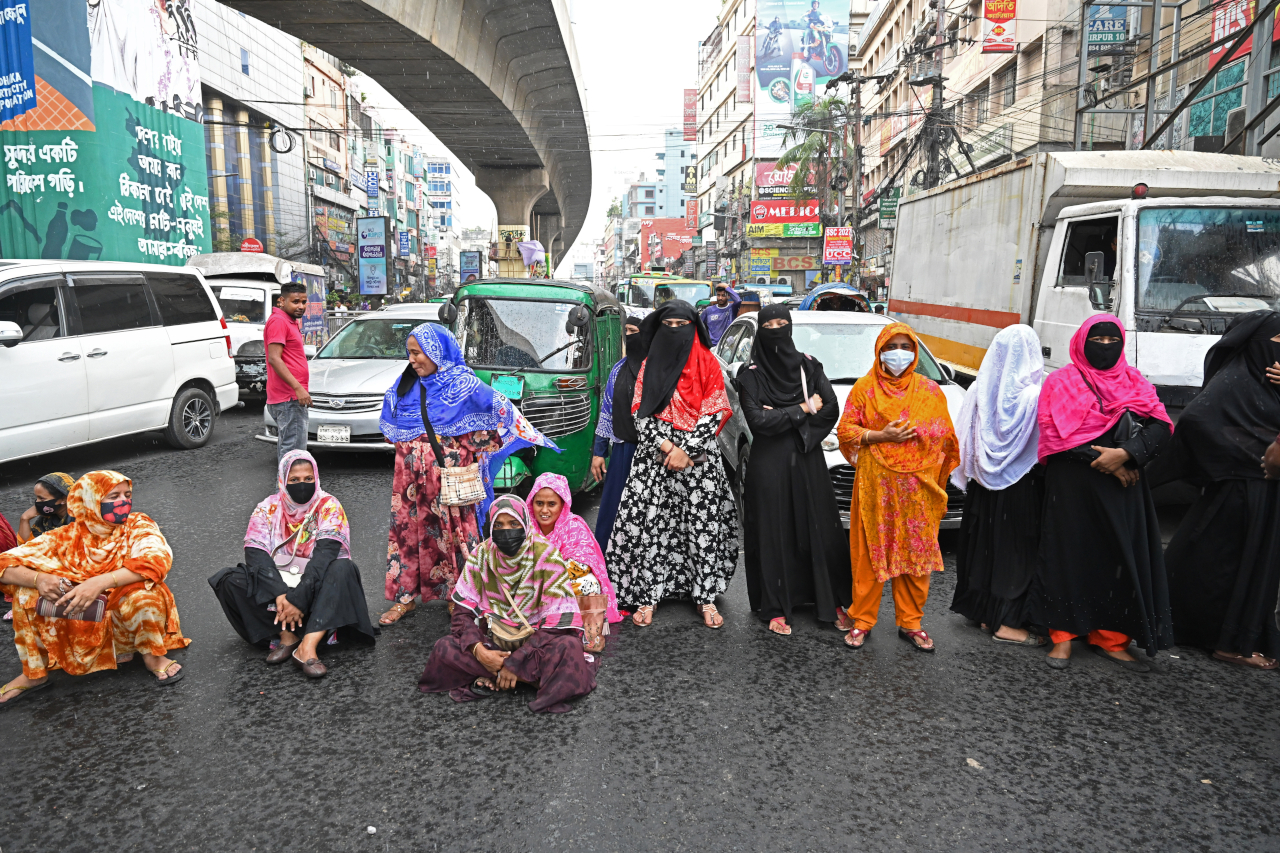
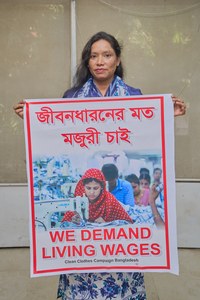
Garment workers in Bangladesh have taken to the streets of Dhaka to protest for higher wages. Their current minimum wage of Tk12,500 is not enough to live on, especially since the prices of basic goods, rent and medical aid have increased significantly since wages were last reviewed in 2023. Meanwhile, the biggest fashion giants on the planet continue to profit from cheap labour costs in Bangladesh.
Kalpona Akter, President of the Bangladeshi Garment & Industrial Workers Federation put it like this: “the unrest that we have seen in the past couple of days is the result of a strong feeling of injustice about how wealth is distributed in this supply chain, and years of trying to get by on a wage that is simply not enough.”
Join us in calling on brands buying from Bangladesh to support workers’ demand for Tk32,000 per month!
If you add your name to the letter below, representatives of top buyers from Bangladesh (H&M, Zara, Primark, New Yorker, Next, Kontoor Brands, Bestseller, C&A, LPP and Marks & Spencer) will get a direct email from you. This gives off a strong signal that you and other consumers want brands to stop exploiting workers in Bangladesh and immediately take action to support workers’ demand for a minimum wage of Tk32,000 per month!
Brands whose suppliers have taken part in the repression need to press their suppliers to drop all charges, rehire all dismissed workers with back wages, immediately end worker dismissals and express their strong concerns about this crackdown on workers’ rights and organising to the Government of Bangladesh, the Bangladesh Garment Manufacturers’ and Exporters Association (BGMEA), and publicly.
Brands need to ensure compensation, in accordance with international standards, to the families of the four workers killed in the protests and to the workers who were brutally injured in the violent police crackdown.
Use the tool below to email representatives of these brands:
Who decides on the minimum wage in Bangladesh?
The minimum wage is negotiated by a tripartite Wage Board, in which representatives of the government, employers and unions have a seat. In past Wage Boards, workers were often not truly represented, as the previous government of Bangladesh appointed leaders of government-affiliated unions to take part in the negotiations rather than leaders of independent trade unions. This year at least one independent union leader has a seat on the Wage Board – Babul Akter from the Bangladesh Garment & Industrial Workers Federation. According to ILO standards, the Wage Board must make its decision based on a number of factors, to ensure the outcome is a balanced representation of the different interests of parties at the negotiating table: competitiveness of the sector, economic interests but also rising costs of living should be carefully weighed. The fact that current wages are so low and the gap between what workers are earning and what they are need to survive is a sign that, in the past, workers’ interests have been ignored too often.
Why is CCC calling on brands to support workers’ demand for a higher wage?
Brands have the power to positively influence wage negotiations for the garment sector because they are the ones dictating the prices in the industry. The garment sector is the most important financial and very profitable export sector of the Bangladeshi economy. During every minimum wage negotiation about wages for the sector, Bangladeshi suppliers and the government argue that brands will lose its competitive advantage (cheap labour) if wages go up by too much and brands will start placing their orders elsewhere. By publicly supporting the wage demand of workers and by publicly committing to absorbing the increased price of labour costs in their purchasing prices, brands can easily debunk this argument and counter this fear for capital flight.
Why does the protection of workers' rights require extra attention now?
During and after the minimum wage negotiations in Bangladesh in 2016, 2018 and 2023, workers who were protesting were met with severe repression. The 2023 wage negotiations eventually resulted in a huge disappointment for workers, who were demanding a minimum wage of Tk23,000 but got a minimum wage of Tk12,500. In response to this outcome, workers took to the streets, where they were met with unprecedented levels of unlawful violence used by both police and factory owners. Four workers got killed, several hundreds got injured and over tens of thousands of workers faced prosecution under one of the many bogus criminal cases that were filed by factory owners and police. Such criminal cases have chilling effect on workers’ right to organise, making it one of the most effective ways used by suppliers to undermine workers’ collective voice and power: unionising. Only after almost 2 years of constant pressure, these criminal cases were dropped. During the first days of the protests surrounding the minimum wage negotiations now, we are already receiving reports of excessive violence being used against workers. One worker was killed during a protest on November 3rd.
What does life look like for garment workers in Bangladesh on their current wages?
Between May and August 2026, Clean Clothes Campaign conducted a research project surveying 1,094 garment workers in Bangladesh on their wages and the impact low wages are having on their lives. The findings were stark: workers overwhelmingly reported being unable to make ends meet and numerous wage and working time violations were reported.
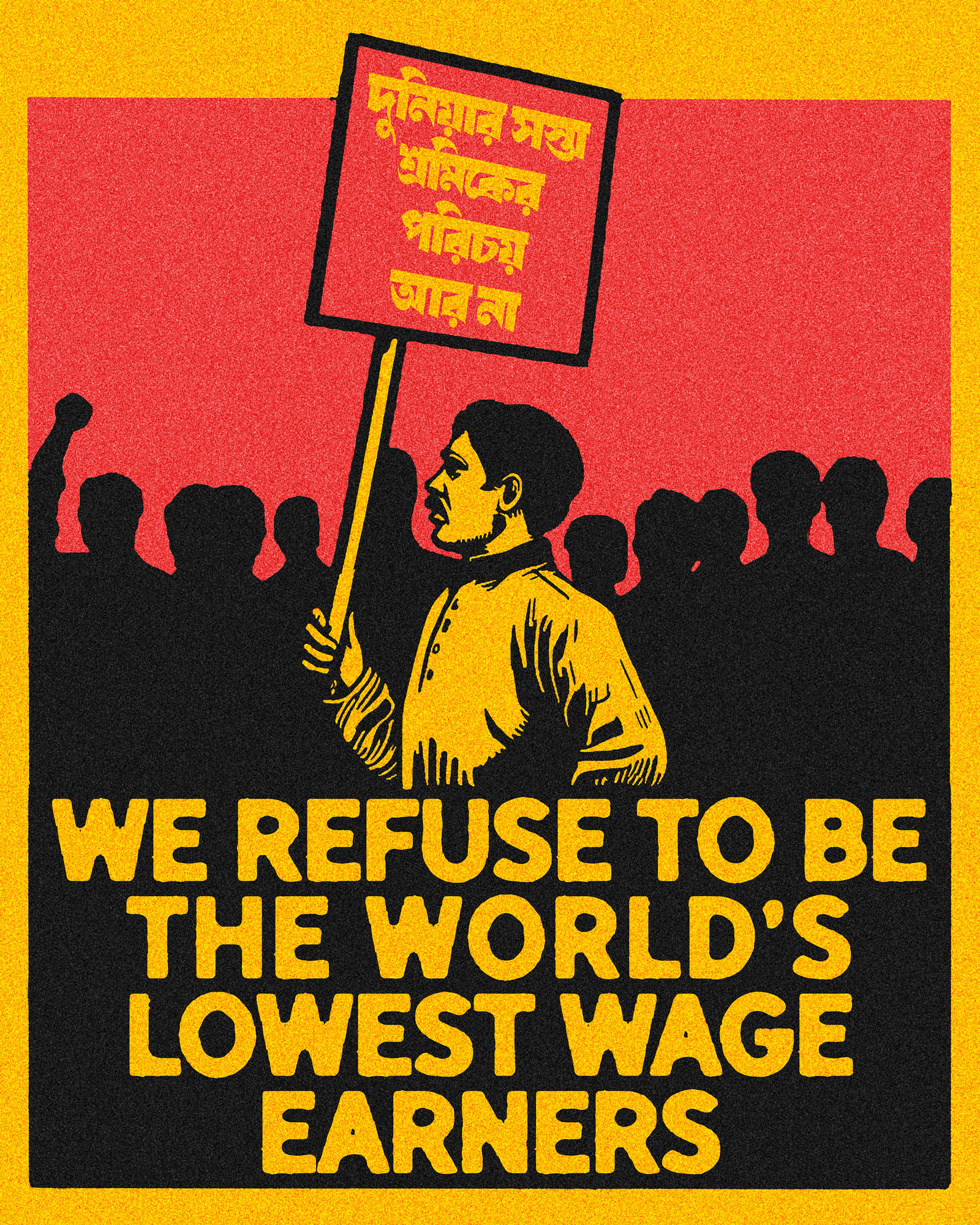
Illustration by Debashish Chakrabarty
All workers reported being paid significantly less than living wage across living wage benchmarks. For the lowest paid workers, their take-home pay was 26% of the Asia Floor Wage 2024 estimate, leaving them 74% short of the benchmark. Against the Anker 2025 estimate for Dhaka’s satellite cities, these workers earned 55% of the estimate, leaving a shortfall of 45%.
89% of workers reported that their wage is not sufficient to cover their family’s basic expenses.
To try to make up the shortfall, workers reported having to resort to precarious and physically taxing coping strategies, including working extra overtime at their factory (28%), taking out loans (25%) and borrowing from friends and/or family (70%).
Reports of wage and working time violations were rife in the sample, with 20% of workers reporting that they were being paid less than the minimum wage for their grade and 13% reporting experiencing illegal wage deductions. Furthermore, 21% reported being made to work more than 2 hours of overtime per day and 17% reported they were forced to work overtime that was unpaid or not properly recorded.
The findings also expose serious shortcomings in the effectiveness of brand audits and their ability to capture workers’ experiences. 76% of workers reported that they do not feel able to speak freely to inspectors or auditors that come to their factory to speak to them about their wages and working conditions.
These findings will be published in a report in December 2026. Due to the evolving situation in Bangladesh and the urgent need to highlight the realities facing garment workers, we have decided to share these findings ahead of the report’s publication. If you have any questions about the research, please contact fashionchecker@cleanclothes.org.
How would a minimum wage increase for workers in Bangladesh affect the price of garments sold in my country?
That depends on decisions made by brands on how they choose to finance an increased purchasing price: either by making slightly less profit and paying their CEO and shareholders a tiny bit less at the end of the year, or by cutting the marketing budget a little bit, or indeed – by increasing the prices of their products a bit. It is important to note that garment workers’ wages only make up a fraction of the price that consumers pay for clothes. A very general rule of thumb: brands roughly pay a quarter of the price that you pay for an item to their suppliers. From the price they pay their suppliers, only between 3-10% is reserved for direct labour costs (workers’ wages). So an increase of garment workers’ minimum wage should not impact the price you pay too much. However, research by Clean Clothes Campaign and Public Eye, published earlier this year, shows that many brands did not even increase their purchasing price after past minimum wage increases. In other words: the price that brands pay for cotton t-shirts sourced from Bangladesh has remained stable for the past 25 years, despite inflation, rising costs of raw materials and rising costs of labour.
For press inquiries on this specific topic please contact Anne Bienias at annebienias@cleanclothes.org to get in touch.