Historic victory in Italy: court rules luxury brand Montblanc is actual employer of workers at Chinese-run subcontractor
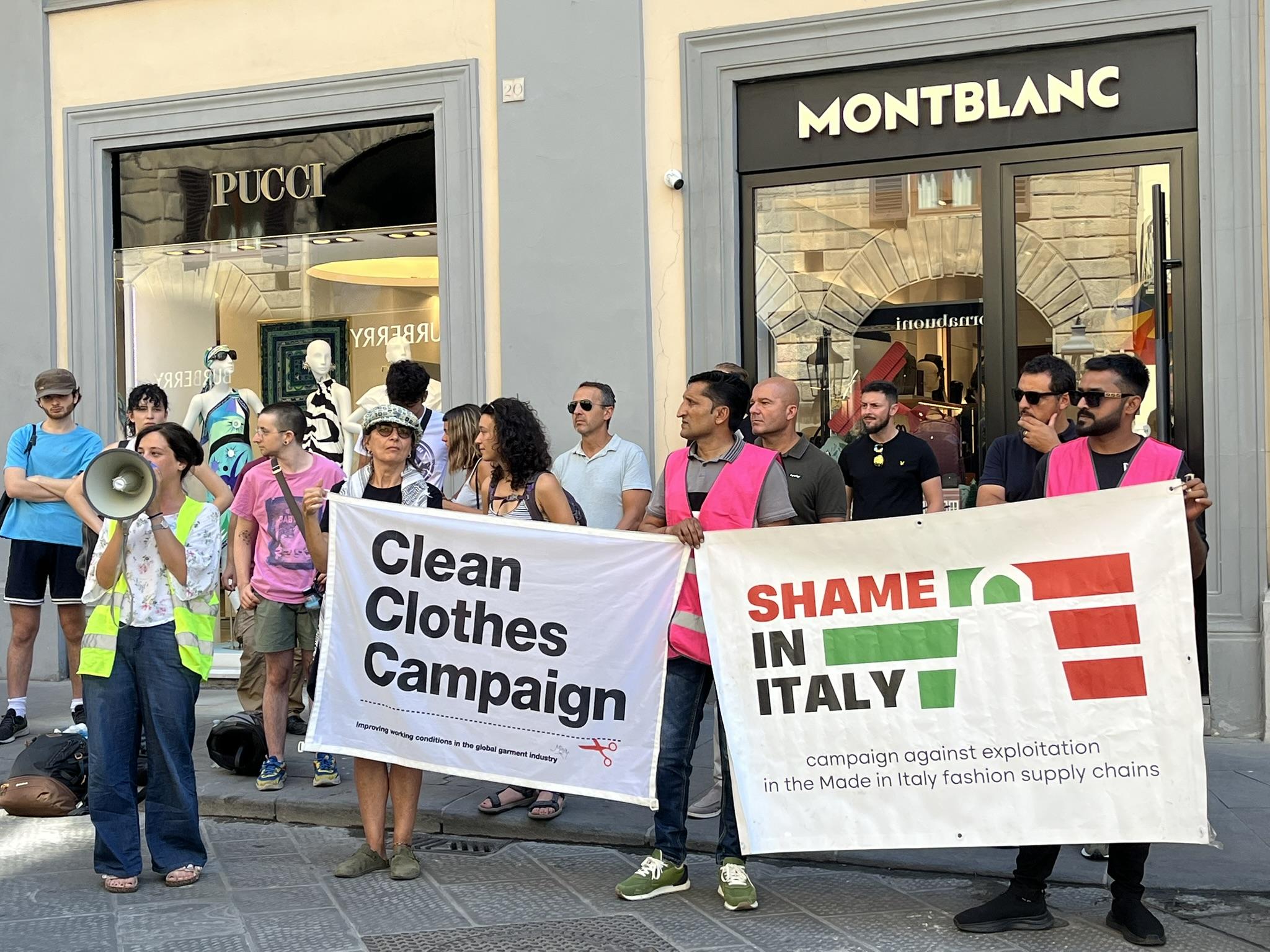
Florence, 1 July 2025. Contract workers from Montblanc, SUDD Cobas and Campagna Abiti Puliti (CCC Italy) are staging a protest outside the boutique on Via Tornabuoni.
Florence, November 27th 2026 - Yesterday the Court of Florence made a landmark ruling set to leave its mark on the entire fashion industry. This is a ruling that lifts the veil on a business model which uses subcontracting to exploit workers and cut costs, whilst shifting responsibility onto external parties.
The ruling concerns a group of workers from Pakistan who produced bags for luxury brand Montblanc (part of the Richemont Group). They did so at Chinese-run subcontractors Z Production and Eurotaglio in Campi Bisenzio, Florence, Italy. While the handbags they were making were sold for €1500 a piece, the workers were enduring 12-hour shifts, six days a week, for which they were paid just €3 per hour on illegal terms. In 2022, thirteen workers, mostly Pakistani, joined trade union SUDD Cobas and, following strikes, secured regular, permanent contracts and a 40-hour work week. A month after the workers had finally secured regularised employment, Montblanc moved the orders to another anonymous warehouse a few kilometres away and mass redundancies began.
On 1 July 2025 six of the affected workers started a court case against Montblanc seeking a ruling that their subcontracting arrangement was not genuine, that they be recognised as employees of Pelletteria Richemont Firenze, and that they be reinstated in the supply chain.
In yesterday’s ruling, the Court recognised the workers’ right to return to their jobs. Moreover, it recognised their right to receive all wages for the months elapsed from the date of their dismissal (which took place in October 2024) until the date on which they actually returned to work. Finally, the Labour Court has ruled that the workers are entitled to return to work, but this time they will be recognised as direct employees of Pelletteria Richemont Firenze (an Italian subsidiary of the financial group Richemont, which owns the Montblanc brand).This last ruling is even applied retroactively: the Court finds that the workers, although formally employed by Z Production (a Chinese-run subcontractor), should be regarded as direct employees of the brand from the date of their initial recruitment. Their employment constituted, in essence, unlawful labour intermediation. Through its own ‘industrialiser’, the brand directly controlled the production process and the work of the workers themselves. The brand, which throughout two years of bitter industrial action had consistently claimed to be ‘uninvolved’ in this matter, has been recognised as the sole and actual employer of the workers, following the finding that the subcontracting arrangement was not genuine. This is the most important finding.
Francesca Ciuffi and Luca Toscano (trade union SUDD Cobas):«This ruling finally recognises the validity of our case. It rewards the courage of these workers and exposes Montblanc’s hypocrisy. It is a cause for celebration that comes after an extremely tough struggle, which saw us manning the gates and climbing onto the factory rooftops, before taking our protest all the way to Richemont’s headquarters in Geneva, Switzerland. Many told us it was a lost cause. A handful of Pakistani workers, together with our small trade union, ultimately defeated a billion-dollar financial conglomerate. David defeated Goliath. The workers have always said: ‘Not for us, but for everyone’. And indeed, today the entire fashion industry feels the ground shaking beneath its feet, because Montblanc is not an isolated case. When we talk about exploitation in the fashion industry, we must address the responsibilities of the major commissioning brands, which have established a business model that relies on untrustworthy companies, whose very existence serves to maximise profits through exploitation and tax evasion. So much for ‘outsiders’ . After years of struggle, the L’Alba dispute (which led to Patrizia Pepe and Dixie being placed under administration) and this Montblanc case show us that there are no lost battles, only battles that must be fought to the very end. Together with the Montblanc workers, we have taken on the responsibility to do so, without being deterred by lawsuits, fines or mountains of lies.»
Lawyer Danilo Conte (acting as co-defence counsel alongside Lawyer Marco Tufo) states: «The Florence Labour Court has ruled that the contract between Richemont and Z Production was not genuine and, consequently, that the “real” employer was Richemont. As a result of this finding, the judgement orders Richemont to reinstate the employment relationship and therefore to re-employ the six workers directly. It also orders the company to pay all outstanding wages and to make social security and welfare contributions. Italian institutions do not always show their best side to those from the Global South. The court’s ruling, however, is an example of how even the most vulnerable, even the most ‘excluded’, can obtain justice if supported by a network of solidarity and struggle, by organising themselves and defending their rights.”
Campagna Abiti Puliti, which is the Italian section of the international Clean Clothes Campaign network, has supported the dispute from the outset alongside Public Eye, an NGO based in Switzerland – the country where Richemont is headquartered. The Campaign organised a number of days of action across Europe, including in Milan, Italian’s fashion capital, on 26 October 2024. On 1 July 2025, the day of the first court hearing, it demonstrated alongside SUDD Cobas outside the Montblanc boutique in Florence. The Public Eye investigation was also decisive.
«We have stood by SUDD Cobas and the workers at Z Production from day one, and we will continue to do so until this is over» says Deborah Lucchetti, national coordinator of the Clean Clothes Campaign Italy. «This case lays bare the luxury industry’s production model: a model in which profit is the only thing that matters. Brands fragment production into chains of contracts and subcontracts, impose prices on suppliers that do not even cover the cost of a living wage, and then claim to have no involvement in what happens in the factories. And when workers organise themselves and secure their rights, the client moves the orders elsewhere. This ruling puts an end to the excuse that ‘it was the supplier who failed to meet the standards’: whoever commissions the production is responsible for the conditions of all workers in the supply chain. This is all the more true when, as in this case, the supplier works exclusively for the client and the client intervenes directly in the organisation of the work, to the extent that it effectively becomes a branch of the client’s own organisation. This is the principle of due diligence and the duty of care provided for in the European Corporate Sustainability Due Diligence Directive, which Italy must transpose by July 2028.»