Green Industry, Grey Realities: FAIR releases new investigation into Bangladesh’s garment factories
Planetary-boundary-compatible production, workplace safety and living wages:
a just transition in fashion can only be achieved through workers’ agency and participation
Green Industry, Grey Realities. Between LEED’s factories and Just Transition: pathways for the RMG sector in Bangladesh. This is the title of the new report produced by FAIR, the organisation coordinating Campagna Abiti Puliti (CAP), part of the international Clean Clothes Campaign (CCC) network, dedicated to improving working conditions and empowering workers in the global garment and sportswear industry.
The new investigation — with data collected between October 2024 and May 2025 — was carried out in collaboration with the Bangladesh Centre for Worker Solidarity and assesses the garment industry in Bangladesh, a key sourcing country for many fashion brands found on high streets across Europe and beyond. These include Benetton, Bestseller, Decathlon, Fruit of the Loom, GAP, H&M, Hugo Boss, Kiabi, M&S, NEXT, OVS, Zara and Wrangler. The aim of the research is to simultaneously promote environmental protection, workers’ rights and quality employment — the core pillars of a just transition.
Following a qualitative snapshot of current conditions, the FAIR report offers a series of concrete recommendations to advance a just transition. These include a call for all companies operating in Bangladesh that did not yet sign the International Accord for Health and Safety in the Textile and Garment Industry Bangladesh Program (Decathlon, Fruit of the Loom, Gap, Kiabi and Wrangler), the binding mechanism established in the aftermath of the Rana Plaza collapse.
Brands already participating in the Accord are urged to use their leverage to ensure that heat stress and other climate-related risks are included in inspections and binding corrective action plans for suppliers, while also guaranteeing fair purchasing prices and responsible business practices.
Brands, suppliers and the Government of Bangladesh are further called upon to ensure — through effective collective bargaining and binding regulations — the adoption of measures to prevent and address all forms of Gender-Based Violence and Harassment (GBVH) in factories, and to guarantee that workers can freely form and join trade unions of their choice without fear of retaliation.
Recognising and implementing a living wage is also essential. A living wage should be understood as a primary climate adaptation measure, enabling workers to choose safer housing, access nutritious food, and invest in ventilation, insulation or cooling systems to cope with the impacts of the climate crisis.
Since the 1980s, Bangladesh has been a major player in the global garment industry. In 2010, it became the world’s second-largest apparel exporter after China, with export revenues of around USD 12 billion, rising to over USD 34 billion by 2019. This growth has been driven by tax breaks, export incentives and a low-cost workforce — conditions that laid the foundations for the fast fashion model.
Today, the textile sector employs around 4 million workers, the vast majority of whom are women, across approximately 4,000 factories nationwide. Among these, 248 factories have obtained LEED (Leadership in Energy and Environmental Design) certification, a widely promoted standard for environmentally sustainable buildings and reduced energy consumption that has helped many brands enhance their public image. Bangladesh is now the global leader in the number of LEED-certified garment factories.
However, this is not enough. LEED certification labels factories as “green” even when they fail to guarantee decent working conditions, adequate wages or trade union presence — all of which are essential to defining a company that truly protects its workers.
The investigation, which focused in particular on eight LEED-certified factories, all of which lack any form of trade union representation, found a 70% gap between actual wages and an estimated living wage. Numerous testimonies collected from workers highlight their inability to lead a dignified life.
Interviews with women workers reveal workplaces that appear “green” on the outside — with modern lighting and solar panels on rooftops — but conceal “grey labour” inside: exhausting work rhythms, heat stress, gender-based violence, poverty wages and a climate of fear that discourages complaints due to the risk of retaliation.
As Fatima explains:
«Only the outside looks some-what clean. The environment is nice to look at from outside. Internally, policies are not properly followed [...] Work procedures and rules look good from the outside but are not followed in practice. This factory is ‘green’ in name only».
Shima adds:
«If you see the factory from the outside, or if you come for a visit, you will be impressed by it. It looks nice, like it’s a garden. But what’s the point if we can’t work in peace? We told our supervisors many times about the issue [of extreme heat], but there has been no change. We even asked for curtains, if nothing else, to spare us from the direct sunlight, but to no avail».
Reshma recalls the shared experience of workers in the factory:
«All workers very passionately stated that this [dusty workplace] was their biggest health-related or environment-related concern. The building is air-conditioned and the AC is on at all times. But there is not enough ventilation or exhaust fans to pull the dust out, as a result of which workers fall sick very often. Workers are constantly coughing or sneezing, and they pointed that out. They said that they have complained to the management on several occasions over the past six years, but no action has been taken, except they have been asked to wear masks. But the extent of the dust is so severe, masks can’t protect us».
On this critical issue, Kalpona Akter, a leading defender of garment workers’ rights, recently honoured by the government for her tireless commitment to the rights of garment workers, and President of the Bangladesh Garment & Industrial Workers Federation, states: «Bangladesh is one of the most climate-vulnerable countries in the world. Rising temperatures, flooding and sea level rise are threatening both infrastructure and the health of women workers right now. Without significant investment in climate-resilient infrastructure and the protection of workers, the sector risks facing an unprecedented crisis. We expect the signatories of the International Accord to include climate risks in the programme by 24 April, the 12th anniversary of Rana Plaza».
Thirteen years ago, on this date, the Rana Plaza building collapsed in Dhaka, killing and injuring thousands of workers - a tragedy that exposed the systemic neglect of worker safety and the exploitative logic underpinning fast fashion.
Supporting and implementing the International Accord, is only a first step towards a fashion industry that truly operates within planetary boundaries. As Deborah Lucchetti, spokesperson for Campagna Abiti Puliti, explains: «Top-down green policies, without the involvement of the working class in the various stages of the transition, are neither sufficient nor effective in achieving a clean, fair and democratic fashion industry within planetary boundaries. To do so, structural and systemic change is needed, at national and international level. An immediate first step that brands still reluctant to support the Accord can take is to sign it».
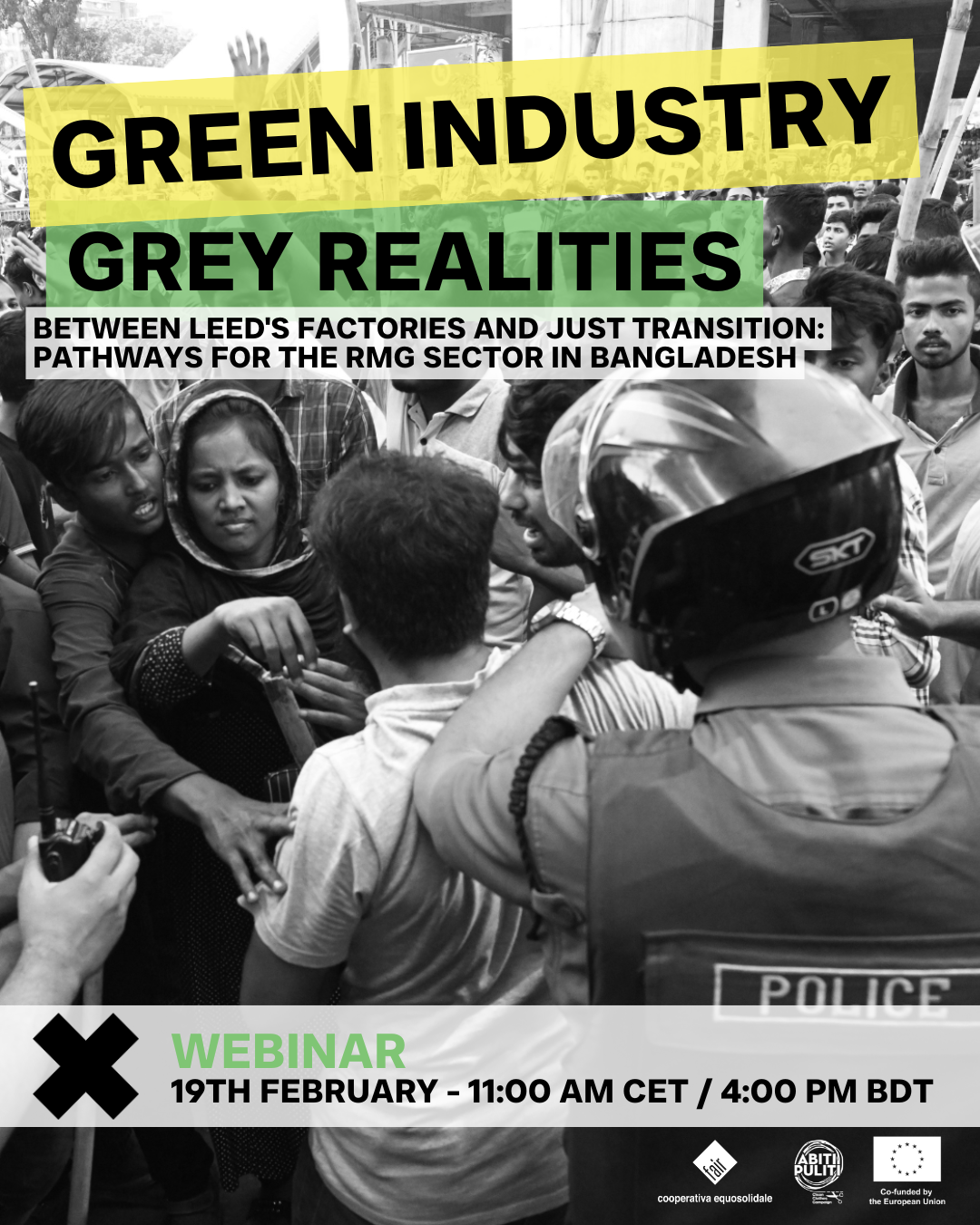
You can join a presentation of the research on Thursday, 19 February at 11:00 AM (CET) / 4:00 PM (BDT) via Zoom, with contributions from Kalpona Akter, Emanuele Leonardi (University of Bologna), Deborah Lucchetti, Aileen Robinson, and Bangladeshi trade union representatives (SUDD Cobas). Register HERE to join the meeting.