Fashion’s secret pricing: workers suffer as brands defy inflation for decades
A report published today by Public Eye and Clean Clothes Campaign for the first time lifts the veil on fashion brands’ pricing policy. Their research shows that many buyers source a standard cotton T-shirt at only around USD 2–3 per piece, with unit prices below USD 1 persisting in parts of the market. While many of these companies make ever more sweeping promises about sustainability and workers’ rights, they continue to squeeze suppliers into keeping prices at unsustainably low levels. Taking global inflation into account, companies now buy a T-shirt for half the value it had 25 years ago.
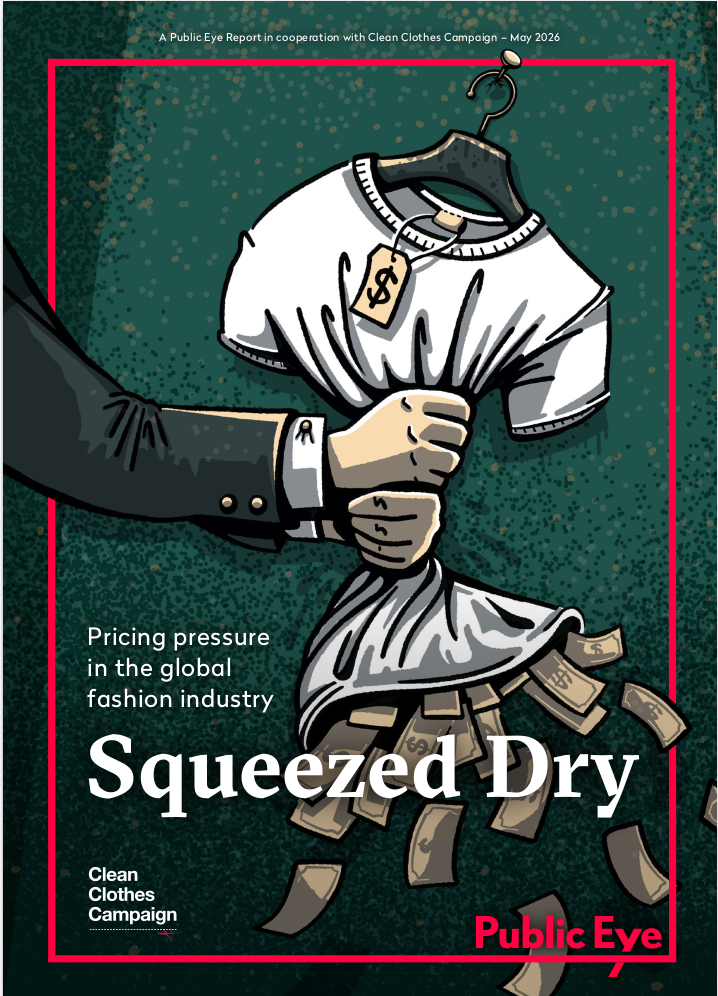
Focusing on fashion’s best-known item, cotton T-shirts, the pioneering report shows that apparel brands have persistently shifted sourcing towards locations that offer the lowest prices at scale. Today, an overwhelming 61% of cotton T-shirts imported into the EU are made in Bangladesh. The average EU import price for a cotton T-shirt in 2025 was just USD 2.67 (EUR 2.36). For T-shirts imported from Bangladesh, the price was even lower, at USD 2.06 (EUR 1.83) in 2025.
Based on trade data and interviews with suppliers and merchandisers, the report reveals that brands enter negotiations with fixed target prices. They know that if one factory refuses their conditions, they will find another factory willing to accept, due to the highly competitive market situation. This forces factories to accept orders that do not reflect the cost of responsible production. As suppliers have little influence over material or energy costs, labor conditions are the first to suffer, with suppliers cutting spending to ensure safe workplaces or pushing workers into forced overtime at a poverty wage.
A closer look at the six highest volume buyers of cotton t-shirts from Bangladesh over the past five years, including Inditex (Zara), Primark and H&M, shows that none of them have increased sourcing prices to keep up with global inflation. Even among higher paying brands, sourcing prices from Bangladesh rarely exceed USD 18 per kg (about USD 3 per piece), while discounters and Business to business companies often source at USD 10 per kg and below.
David Hachfeld of Public Eye, one of the report’s authors, says: “Relentlessly low sourcing prices are the organising principle of today’s garment industry, shaping sourcing geographies, buyer behaviour and structurally locking-in poverty wages. A transition towards a just and sustainable fashion system based on two-dollar shirts and other dirt-cheap clothing is impossible, full stop.”
The low sourcing prices prevent the payment of living wages. The report therefore proposes a fundamental revision of the garments pricing system, from the current top-down and cost-cutting system to a bottom-up and cost-covering calculation in which living wages and decent working conditions are not negotiable prerequisites. As brands will not act on their own, policy measures are needed to enable this shift.
Kalpona Akter, president of the Bangladesh Garment and Industrial Workers Federation, states: “The fashion brands which brag about human rights policies actively contribute to the continuation of poverty wages by their downward pricing policy. Higher prices are needed for living wages, safe workplaces, and sustainable production.”