At a decisive moment, some brands seem to deprioritise worker safety in Pakistan
On 3 February 2026 the International Accord for Health and Safety in the Textile and Garment Industry announced the list of signatories to the renewed Pakistan Accord, effective from 1 January 2026. The global trade union federations and brand representatives agreed to renew their commitment to the Pakistan Accord in its current form, for a duration of one year (until 31 December 2026) and with automatic renewal for another three years. As a witness signatory to the Accord, Clean Clothes Campaign (CCC) applauds the high sign-on rate, while urging those brands that are still on the fence to renew their commitment as soon as possible.
Thus far, over 100 brands of the 143 that signed the first Pakistan Accord have already re-signed, with more still expected to follow. Two companies that have not yet renewed their commitment are LPP, from Poland (one of the brands linked to the Rana Plaza disaster in 2013) and Hugo Boss, from Germany. Commercially available trade data shows that LPP has a major presence in Pakistan, with over 100 suppliers. Hugo Boss reports working with eight Tier 1 factories in Pakistan according to their public supplier list. Many of these factories have undergone initial safety inspections by independent Pakistan Accord safety engineers which uncovered hundreds of life-threatening safety hazards requiring urgent and time-bound action.
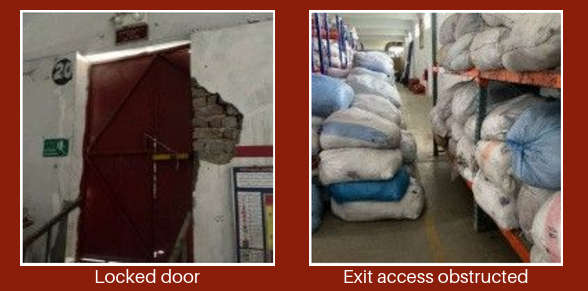
Remediation is just at the beginning stage at many factories. For example, at Mount Fuji Textiles, a supplier to LPP, numerous lockable gates were found, putting workers at immediate risk of getting stuck inside the building in case of an emergency. Similarly, lockable gates and storage blocking the exit paths were found at Hugo Boss supplier Kamal Mills. The public Corrective Action Plans indicate that these issues still need to be resolved. LPP and Hugo Boss need to ensure that the risks that have been identified will be remediated and that their suppliers can afford to do so.
“By failing to renew their commitment to the Pakistan Accord by the intended deadline, brands are knowingly refusing to participate in the necessary remediation to ensure safe working conditions for workers producing their clothes”, says Nasir Mansoor of the National Trade Union Federation in Pakistan. At best, the workers in these factories are lucky enough to have another Accord signatory brand continuing sourcing from their factory, and the factory remains covered. This remains to be seen pending the release of new supplier data. At worst, the workers lose the protection of the Accord altogether, with brands falling back on demonstrably unreliable corporate-controlled codes of conduct and voluntary audit schemes.
Unfortunately, some major brands continue to rely on these weaker alternatives. Ikea, Decathlon and Wrangler have been the target of an ongoing public campaign from CCC for refusing to commit to the binding Accord mechanism. In addition to this ongoing campaign, CCC is calling on consumers, citizens and activists in countries where LPP and Hugo Boss products are sold to put pressure on them to renew their commitment.
Ineke Zeldenrust from CCC explains: “We are deeply concerned that some brands may be exiting the Accord, thereby avoiding the responsibility and the commitment to offer commercial terms that make remediation feasible, as required by the Accord. It is the worst type of cut-and-run, where these brands have identified the risks, but refuse to prevent, mitigate and remedy them through a trusted and proven human rights due diligence process, as provided by the Accord. We are not talking about small brands with only a few factories - this can potentially affect tens of thousands of workers”.