Activists call on German brand OTTO to ensure justice for workers
Ahead of International Migrants’ Day, the Clean Clothes Campaign (CCC) calls on OTTO to recognise the claims of the 209 former workers of Royal Knitting and to actively work towards resolving the case. Since 2020, the affected have been fighting for unpaid wages and severance pay. More than 90 per cent of them are migrant workers from Myanmar, who live in particularly precarious conditions in the border region of Mae Sot (Thailand). They produced goods for OTTO brands and lost their livelihoods when the factory closed.
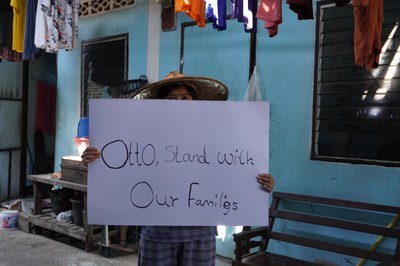
The former workers of Royal Knitting have given testimony and presented substantiated documents proving that production for OTTO brands took place at Royal Knitting until 2020. Instead of acknowledging its responsibility, the company disputes the credibility of the affected workers’ statements and casts doubt on the authenticity of the evidence. The CCC calls on OTTO: #BelieveTheWorkers! The Hamburg-based company must finally place trust in the statements of the former workers and documents, and use its influence over its suppliers as well as all available means to make a constructive contribution to a final resolution of the case.
The Royal Knitting case shows that migrant women in the garment industry are particularly affected by human and labour rights violations. “Mae Sot has for years been regarded as a ‘black hole’ for labour rights. Millions of people from Myanmar are forced by poverty to seek work in Thailand,” reports Brahm Press, Director of the Thai MAP Foundation, which has supported migrant women on the ground for decades. “Factory owners in the region exploit the oversupply of cheap labour from Myanmar and pay below the legal minimum wage – that was also the case at Royal Knitting.” Even before the factory closed, it was clear that, since 2018, workers had been denied an average of 12 to 18 months’ wages due to pay below the minimum wage, Press continues. The total amount came to almost 850,000 euros. Thailand’s Supreme Labour Court confirmed this claim.
OTTO argues that it has not had a business relationship with Royal Knitting since 2017. However, in proceedings under the German Supply Chain Due Diligence Act before the Federal Office for Economic Affairs and Export Control (BAFA), OTTO stated that it maintained a business relationship with Yamaken Apparel until 2020, which held 84.5 per cent of Royal Knitting at the time of the factory closure. Former workers consistently report that they produced goods for OTTO brands until 2020 and submitted brand labels as well as production, packaging and order documents clearly identifying OTTO brands as the client.
“OTTO emphasises that the subcontracting of production orders was contractually excluded. At the same time, the company ignores the very real possibility that orders were outsourced by Yamaken Apparel to its subsidiary Royal Knitting without OTTO’s knowledge. For the Clean Clothes Campaign, the statements and evidence provided by the affected workers are convincing. We do not consider it an appropriate strategy to cast doubt on their testimony in order to evade corporate responsibility and simply wait the issue out. We call on OTTO: Believe the workers! It’s time to show responsibility!” says Felix Nickel, of CCC Germany.
The workers’ demands are supported by numerous civil society actors and experts who, in an open letter, call on OTTO to end legal intimidation measures against the CCC and to enter into serious negotiations with those affected.
“In the spirit of OTTO’s current advertising campaign, we join the former workers and say: ‘For joy that lasts’ – it is time for justice! We call on the OTTO Group: #BelieveTheWorkers! It is time to sit down at the table and resolve this issue constructively. We invite the company to a direct meeting with the affected former workers,” says Felix Nickel on behalf of Clean Clothes Campaign (CCC).